GrapheneOS vs Stock Android vs iPhone: Which Is Actually More Private?
GrapheneOS, stock Android and iPhone all take different approaches to privacy, security and user control. This guide compares Google integration, Apple’s privacy protections, GrapheneOS hardening, app compatibility and carrier-level exposure to help you decide which mobile operating system best fits your privacy needs
By GhostSims Team ·
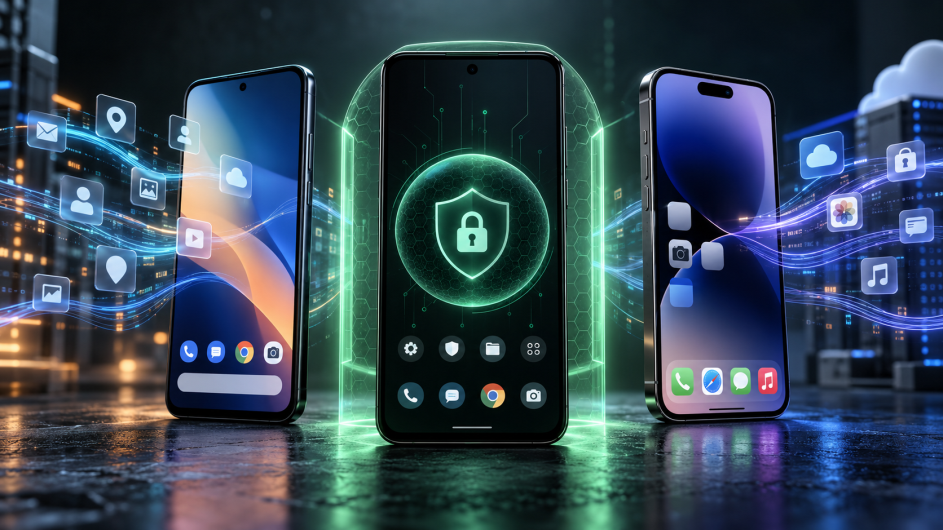
If you are comparing GrapheneOS, stock Android and iPhone because you want a more private phone, the difficult part is separating meaningful protections from marketing claims. Google, Apple and GrapheneOS take different approaches to data collection, app permissions, security and user control. GhostSims works with privacy-focused mobile setups, so this guide compares those trade-offs without pretending that one operating system is perfect for everyone.
The short answer is that modern iPhones offer strong privacy protections against third-party tracking and strong hardware security. Google-equipped Android gives users substantial privacy controls, but Google Play services and other Google components remain integrated into the normal experience. GrapheneOS changes that model by excluding Google apps and services by default, adding additional privacy and security hardening, and allowing Google Play to be installed as ordinary sandboxed apps if you need it.
But before asking which operating system is more private, there is a more important question.
Private From Whom?
Privacy is not one feature.
You might be trying to reduce exposure to:
advertising networks and data brokers
app developers
Google or Apple
your mobile carrier
someone who gains physical access to your phone
attackers exploiting software vulnerabilities
An operating system can perform strongly in one area while making different compromises elsewhere.
An iPhone, for example, gives users meaningful control over third-party tracking while still requiring them to rely on Apple as the developer and operator of the platform. GrapheneOS reduces Google's privileged role in the operating system, but it still depends on supported Pixel hardware, firmware and the manufacturer's device-support lifecycle. GrapheneOS itself notes that its device support ultimately depends on upstream hardware and firmware support.
That distinction matters more than simply asking whether Android or iPhone is "private."
Stock Android: Strong Privacy Controls, but Google Is Still Integrated
First, a definition.
In this article, stock Android means the Google-equipped Android experience found on Pixel phones and similar devices using Google Mobile Services. The Android Open Source Project by itself does not automatically include Google's proprietary services.
Modern Android provides useful privacy controls. The Privacy Dashboard can show which apps have accessed sensitive permissions such as the camera, microphone and location, and users can change those permissions. Google's Usage & Diagnostics setting can also be switched off.
That does not mean switching one setting off stops every connection to Google.
Google explains that Play services may collect information about the device, installed software and how certain services and APIs are used. Additional information may be collected depending on settings, such as when Usage & Diagnostics or Google Location Accuracy is enabled.
So the privacy issue with Google-equipped Android is not that users have no control. They have plenty.
The difference is that Google services are deeply integrated into the mainstream Android experience. For someone who wants excellent app compatibility, familiar Google services and minimal configuration, that may be an acceptable trade-off.
For someone deliberately trying to reduce dependence on Google services, it is the main reason to investigate de-Googled phones.
iPhone: Genuine Privacy Strengths, but Apple Still Operates the Platform
Dismissing iPhone privacy outright would be inaccurate.
Apple's App Tracking Transparency requires apps to request permission before tracking a user's activity across other companies' apps and websites for advertising or sharing information with data brokers. Users can deny the request or later change their choice.
iOS also provides granular controls over access to location, contacts, photos, camera and microphone.
App Privacy Report goes a step further by letting users review how apps use granted permissions and which internet domains those apps contact.
Apple also has genuine hardware-security strengths. The Secure Enclave is an isolated security subsystem built into Apple silicon and is designed to protect sensitive data even if the main application processor is compromised.
For someone who wants strong security and useful privacy controls without changing how they use a smartphone, an iPhone is therefore a credible option.
The limitation is the trust model.
Apple develops iOS, controls key platform services and determines how much of the underlying system users can inspect or modify. Users can disable the sharing of iPhone analytics, but Apple remains the platform provider you are trusting to implement and operate those protections. Apple documents its Analytics & Improvements controls separately in iOS.
That is one of the main differences in a GrapheneOS vs iPhone comparison.
iOS gives mainstream users strong privacy protections inside an Apple-controlled ecosystem. GrapheneOS is designed around reducing privileged access for services and giving the user more control over what is installed.
GrapheneOS: Less Default Google Integration and More Granular Control
GrapheneOS is an open-source, privacy- and security-focused Android-based operating system built for specifically supported Google Pixel devices.
Google apps and Google Play are not installed as privileged system components by default.
If you need Google Play, GrapheneOS provides a compatibility layer that lets you install the official Google Play components inside Android's standard app sandbox. They do not receive the special system privileges they normally have on Google Android. They can also be installed only in selected user profiles.
That is a significant architectural difference.
GrapheneOS also adds privacy and security features beyond standard Android. These include a per-app Network permission, Storage Scopes, Contact Scopes and additional exploit-mitigation features. The Network permission can prevent an app from directly or indirectly accessing available networks.
GrapheneOS says the operating system has no analytics or telemetry of its own. It does still make necessary network connections, including connections to GrapheneOS services and configured DNS infrastructure, so "no telemetry" should not be confused with "the phone never connects to a server."
What Do You Give Up?
Mostly convenience and universal compatibility.
GrapheneOS provides broad Android app compatibility, especially when sandboxed Google Play is installed, but not every app behaves correctly.
Financial apps are one of the most common problem areas.
GrapheneOS documentation says some banking apps work without special configuration, many depend on Google Play services, and others perform certification or integrity checks that can cause compatibility issues on alternative operating systems.
That means you should test the specific banking, payment, workplace and authentication apps you rely on rather than assuming that every Android app will work.
There is also a hardware limitation.
As of September 2026, GrapheneOS officially supports Pixel devices from several generations, including the Pixel 8, Pixel 9 and Pixel 10 families, with the Pixel 10a now also receiving official production support. GrapheneOS particularly recommends Pixel 8-generation devices and newer because of their longer support period and newer hardware security capabilities.
If you are considering switching, our guide to which phone to buy compares the practical options.
GrapheneOS vs Android vs iPhone: Privacy Comparison
Area | Google-equipped Android | iPhone | GrapheneOS |
Google services by default | Integrated | Not part of iOS | Not included by default |
App permission controls | Strong | Strong | Strong, plus additional GrapheneOS controls |
Third-party tracking controls | Android privacy and permission controls | Includes App Tracking Transparency | Android controls plus GrapheneOS privacy additions |
Google Play | Integrated with platform privileges | Not applicable | Optional and sandboxed |
App compatibility | Excellent | Excellent within iOS | Very good, but some financial and enterprise apps may fail |
Hardware-backed security | Varies by device; particularly strong on recent Pixels | Strong, including Secure Enclave | Uses supported Pixel hardware security plus additional OS hardening |
Security updates | Depends on manufacturer and model | Controlled by Apple for supported devices | Frequent automatic updates, but device lifetime ultimately depends on Pixel hardware/firmware support |
User control | High | High within Apple's platform model | Very high |
Main platform dependency | Google, device manufacturer and installed services | Apple and selected services | GrapheneOS, Pixel hardware/firmware and whatever services you choose to install |
There is no useful privacy comparison without considering your threat model.
For many ordinary users, a fully updated iPhone or supported Android phone with sensible privacy settings may provide an excellent balance of security, privacy and convenience.
GrapheneOS becomes particularly attractive when reducing privileged Google integration and increasing control over app access are important enough to justify some extra setup.
The Privacy Layer None of These Operating Systems Can Remove: Your Carrier
Changing your operating system does not remove the cellular network.
A phone connected to a mobile network must communicate with cellular infrastructure so the network can provide service. Cellular mobility features such as handover and roaming also create inherent location-privacy considerations. Android's own cellular-security documentation notes that cellular networks expose users to location-privacy risks.
GrapheneOS is very clear about this limitation.
Its documentation states that cellular triangulation can occur whenever a device is connected to the network and that airplane mode is the reliable way to prevent the cellular network from tracking the connected device.
That means GrapheneOS can reduce operating-system telemetry, restrict apps and harden your phone, but it cannot make an active cellular connection invisible to the cellular infrastructure serving it.
This is why the SIM and mobile-service layer should be considered separately from the operating system.
An encrypted SIM card is a service-layer privacy choice rather than a replacement for device security. Whatever SIM you use, you should not assume that it makes an actively connected handset invisible to cellular networks.
Who Should Switch to GrapheneOS?
GrapheneOS may be a good fit if you:
want to minimise privileged Google integration
prefer privacy-first defaults
want greater control over app network and data access
are comfortable using a supported Pixel
are willing to test critical apps before migrating
You may genuinely be better served by iPhone or conventional Android if you:
need maximum app compatibility
depend heavily on Apple ecosystem services
use work, banking or payment apps that reject alternative operating systems
do not want to spend time adjusting profiles or permissions
value convenience more than granular operating-system control
There is nothing inherently wrong with that choice.
A supported and fully updated mainstream phone is generally a much better security decision than running an old or poorly maintained privacy-focused device.
Frequently Asked Questions
Is GrapheneOS more private than iPhone?
GrapheneOS provides a more privacy-focused default architecture for users who want to minimise privileged platform services. Google apps are not included by default, and optional Google Play runs sandboxed. iPhone still offers strong privacy protections, particularly against third-party app tracking, but users remain inside Apple's platform ecosystem.
Is GrapheneOS more secure than iPhone?
There is no accurate universal answer. Both platforms use app sandboxing, hardware-backed security and strong exploit mitigations. GrapheneOS adds substantial hardening to supported Pixel hardware, while Apple tightly integrates iOS with security hardware such as the Secure Enclave. Which model is preferable depends on the threats you are trying to defend against.
Is GrapheneOS better than stock Android for privacy?
For users who specifically want to reduce privileged Google integration and gain additional controls such as per-app network access, GrapheneOS offers meaningful privacy advantages. Google-equipped Android provides excellent compatibility and useful privacy settings, but Google services remain part of the standard platform.
Is GrapheneOS worth switching to?
It can be if reducing Google integration and gaining more control over apps justifies the extra setup and occasional compatibility issue. If convenience and universal app support matter more, staying with an iPhone or conventional Android phone can be perfectly reasonable.
Does GrapheneOS break apps?
Most ordinary Android apps can work on GrapheneOS, particularly with sandboxed Google Play. Some apps can fail because they depend on privileged Google functionality or require Google's operating-system certification. Financial apps are a notable category where compatibility varies.
Can I use banking apps on GrapheneOS?
Many banking apps work, but not all of them. Some require sandboxed Google Play, while others use certification or attestation checks that may reject GrapheneOS. Check your bank's specific app before making GrapheneOS your only phone.
Which phone OS is the most private?
There is no single answer for every threat model. GrapheneOS gives privacy-focused users unusually granular control and avoids bundled Google services. iOS provides strong mainstream privacy controls with less configuration, while Google Android prioritises broad compatibility alongside configurable privacy options.
Build the Rest of Your Mobile Privacy Setup
Changing your operating system can reduce unnecessary data exposure, but it solves only one part of mobile privacy.
You can install GrapheneOS yourself using the project's officially supported web installer or command-line method, so buying a preconfigured device is not required.
If you prefer a device that arrives with the operating system already installed, GhostSims currently lists its GrapheneOS phone range from $550 as of September 2026.
Either route can work.
The important part is understanding what each layer actually protects. GrapheneOS changes the security and privacy model on the handset. Your apps determine what information you voluntarily share. Your SIM and mobile provider operate at another layer, and the cellular network itself remains visible whenever your phone is connected.
Treat those as separate problems, and you can build a much more realistic privacy setup without relying on claims that any single product can make a smartphone completely anonymous.
Order Your Ghost SIM Online or Contact us on Whatsapp +44 7375 695524