How Voice Changers Work: From Pitch Shifting to AI
How voice changers analyse and rebuild your voice, the difference between pitch shifting and AI conversion, why delay matters on calls, and how to use one responsibly.
By GhostSims Team ·
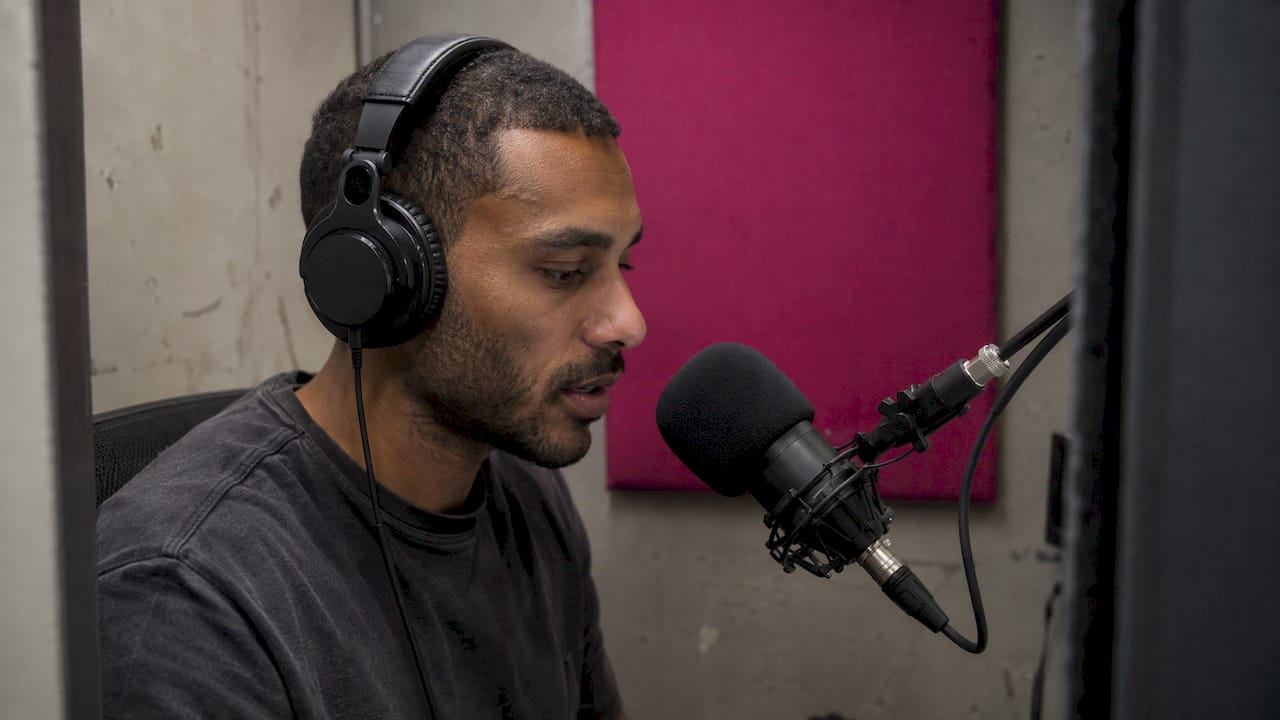
A voice changer takes the sound of your voice, breaks it into measurable parts, alters the parts that make you recognizable, and rebuilds audio you can send down a microphone, a call or a recording. Older tools do this with signal-processing math. Newer ones use trained neural networks. On a live call, the hard part is doing it fast enough that you can still talk naturally. That is why a voice changer built into the phone line itself, like the one on our encrypted SIMs, is a different proposition from an app running on a laptop.
This guide explains each stage in plain terms, so you know what is happening to your voice and what affects the result.
TL;DR
- A voice changer analyzes speech, alters speaker-specific traits such as pitch and formants, and rebuilds the waveform with a vocoder.
- Classic effects use pitch shifting, frequency shifting and filters. AI voice conversion learns a mapping toward a target voice.
- Live use depends on low delay: current systems run in roughly 60 to 70 milliseconds, short enough to talk naturally.
- Microphone quality and processing speed shape how natural the output sounds.
- Use a voice changer to protect your identity, never to impersonate someone else.
What a voice changer actually changes
Your speech carries two kinds of information. One is the content: the words and how they are pronounced. The other is you: the pitch of your vocal folds, the resonance of your throat and mouth, your intonation and rhythm.
Academic work on voice conversion describes the goal precisely. A system modifies only the speaker-dependent characteristics of speech, namely formants, fundamental frequency, intonation, intensity and duration, while keeping the speaker-independent content intact. In everyday terms, the words stay, the vocal identity moves.
Two terms matter here:
- Fundamental frequency is the base pitch of your voice. It is what makes a voice sound high or low.
- Formants are resonant peaks shaped by your throat, mouth and nasal passages. They give a voice its timbre, which is why two people singing the same note still sound different.
A good voice changer shifts both. Move only the pitch and you get a chipmunk or a monster. Move the formants too and the voice reads as a different, believable person.
The three-step pipeline: analyze, map, rebuild
The same overview describes voice conversion as a three-step pipeline of analysis, mapping and reconstruction.
- Analysis. The incoming audio is cut into very short frames and decomposed into an intermediate representation, such as pitch, spectral shape and timing.
- Mapping. A function transforms those features toward the target voice. In simple tools it is a fixed rule, like “raise pitch by four semitones.” In AI systems it is a learned frame-by-frame mapping.
- Reconstruction. A vocoder turns the modified features back into an audible waveform. The vocoder is the component that actually makes sound again.
Every voice changer, from a toy to a research system, follows some version of this loop. The differences are in how clever each step is.
Traditional effects versus AI voice conversion
Traditional voice effects are built from digital signal processing, or DSP: fixed mathematical operations on the audio. The common ones are:
- Pitch shifting, which raises or lowers the base pitch.
- Frequency shifting, which moves every frequency component up or down by a fixed amount, producing the robotic, metallic character familiar from film voices.
- Vocoding, which keeps the shape of your speech and imposes it on a synthetic carrier sound.
- Echo, overlap and multi-pitch layering, which blend delayed or shifted copies of the voice.
A university project on a Raspberry Pi voice changer shows how basic this can be. It reads the microphone in chunks, applies time-domain and FFT-based (frequency-domain) effects, and plays the result back with under half a second of delay. Pitch shifting there is done by rearranging the samples in each chunk.
The strength of DSP effects is predictability and low computing cost. The same input always produces the same output, and the effect runs on almost any hardware. The result, though, sounds clearly processed. A shifted voice is still your voice, only higher or lower.
AI voice changers work differently. Instead of applying a fixed transformation, a neural network trained on large amounts of speech learns what separates one voice from another. It extracts the content of what you say and re-renders it with a different vocal identity. The output can sound like a natural, distinct person rather than an altered version of you. Newer systems are called zero-shot because they can produce a target voice from a short sample without being retrained for it.
A practical way to choose between the two:
| Need | Better fit |
|---|---|
| Quick, light disguise with minimal delay | Classic pitch and formant shifting |
| A natural-sounding different speaker | AI voice conversion |
| Running on modest hardware | Classic DSP |
| Voice that holds up in a long conversation | Well-tuned formant shifting or modern conversion |
Why real-time is the hard part
Converting a recording is easy, because the software can look at the whole clip. Converting a live voice means the software gets a tiny slice of audio, has to decide what to output, and must do so before you finish the next syllable.
Sampling and chunks
A microphone signal is digitized by sampling it thousands of times per second. Human speech occupies roughly 300 to 3,500 Hz, so the Nyquist theorem calls for sampling at least about 7 kHz to capture it. The same guide describes how even a small microcontroller can pitch shift live: it keeps a roughly 10 millisecond “grain” of audio refreshed from the microphone, and shortens or stretches it by dropping or repeating tiny segments.
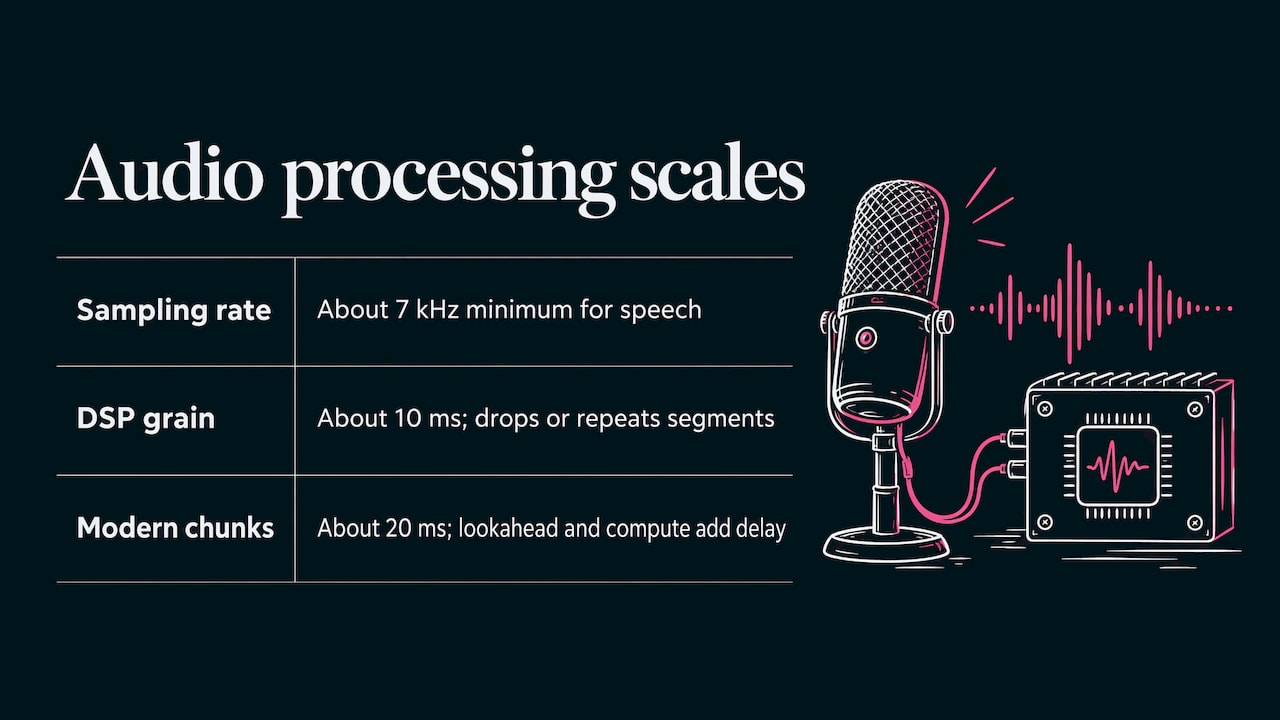
Modern systems do the same thing with far more sophisticated models. They process audio in chunks of about 20 milliseconds, and the sum of chunk size, lookahead and compute time is the delay you experience.
How fast is fast enough?
Researchers have published concrete numbers. StreamVC, a Google-affiliated model, achieved 70.8 ms of end-to-end latency on a single phone CPU core, including 60 ms of architectural latency and about 10.8 ms of processing per 20 ms chunk. It targets calls, video conferencing and voice anonymization. A 2025 system, RT-VC, reported 61.4 ms on an Apple M3 CPU, about 13% faster than StreamVC.
These figures are well below the point where a conversation feels broken. Engineers working in live speech AI treat delay as a design constraint from the start.
Why you hear yourself matters
There is a human factor too. When you hear your own converted voice late, you stumble. NTT’s engineers describe this as delayed auditory feedback, and they designed their model to be causal: it generates output from current and past audio frames only, never future ones, keeping conversion delay to several tens of milliseconds. Lookahead improves quality but adds delay, so the best systems balance the two.
What shapes how natural the voice sounds
A few factors decide whether a changed voice sounds convincing:
- Microphone quality. Conversion quality is ultimately tied to the recording equipment, as the RT-VC authors note. A clean signal in gives a clean signal out.
- Processing budget. A model that must finish in a few milliseconds on a phone chip has less room than one running on a server.
- Lookahead. Peeking a few frames ahead helps the system judge what sound is coming, at the cost of added delay.
- How different the target is. A modest shift in pitch and formants sounds more natural than a dramatic gender or age swap.
- Language and training data. Models are trained on particular speech data, so results can vary by language and accent.
A practical tip for any voice changer: speak at a steady pace into a decent microphone, in a quiet room, and pick a moderate setting. Extreme settings are where artifacts show up.
Software, hardware and network-level voice changers
Voice changers come in three broad forms, and the difference is where the processing happens.
- Desktop and phone apps intercept your microphone and process it before it reaches a game, chat or recording program. They depend on your device’s CPU and on each app’s compatibility.
- Standalone hardware, such as a telephone voice changer box or a microcontroller project, sits between the microphone and the output. It is simple and independent of your computer.
- Network-level changers work inside the call path itself. Your phone placed the call normally, and the voice is altered as part of the service.
The third type matters most for anyone placing calls rather than streaming. An app on your phone has to be running, permitted to use the microphone, and compatible with your calling app. A voice changer that is part of the line works on the call itself.
Voice changing on an actual phone call
For privacy-focused callers, the voice is one of several identifiers. Your number, your SIM’s identity and your call metadata all say something about you. We cover these in our guides on phone call metadata and on why changing your IMSI matters. Masking the voice is the last piece, because a recognizable voice can tie a call back to a person even when the number does not.
Our encrypted SIM cards list a built-in voice changer among their privacy features, alongside encrypted communication and a changeable IMSI. How it fits into the call is described in our article on the built-in voice changer for protecting your identity on calls.
If you are choosing how to use a voice changer on calls, think through these points:
- Decide what you are protecting. Hiding your voice from a recipient is a different goal from hiding your number or location.
- Pick a moderate setting. Subtle shifts keep your speech clear and your delivery natural.
- Keep the rest of the chain private. A disguised voice on a call tied to your real name defeats the purpose. Anonymous registration and a changeable number address that side.
- Test in a low-stakes call first so you know how your voice sounds with the setting you chose.
Our offer for private calling
At the time of writing, the Russian PGP Encrypted eSIM costs $100 one-off and the physical SIM version $115 one-off; the product page always shows the current price. Both are listed on our encrypted SIM page, and our encrypted SIM guide explains how private SIMs work. We sell no-KYC SIMs and eSIMs for 180+ countries, and you can pay with cryptocurrency, cash, card or PayPal.

If you want the phone as well, the same range includes Google Pixel phones with GrapheneOS installed, listed in our shop. Support is available by email, Signal and Telegram.
Using a voice changer responsibly
Voice conversion has become convincing enough that the risks deserve attention. In a 2024 study, people mistook an AI-cloned voice for the real person 79.8% of the time, and they identified a voice as AI-generated only 60% of the time on recordings shorter than 20 seconds. Accuracy rose to a mean of 82.7% for recordings longer than 30 seconds.
Two takeaways for you as a user:
- Use a voice changer to protect yourself, not to pose as someone else. Impersonating a real person to deceive, defraud or harass can be illegal, and the researchers behind RT-VC themselves name impersonation and privacy violations as ethical risks. They say they will withhold open-source checkpoints and explore watermarking or traceable metadata in converted audio.
- Expect others to get more careful too. Researchers suggest that keeping a caller talking past 30 seconds and adding imperceptible watermarks are practical mitigations. Detection work is also moving toward analyzing whole conversations, because a QUT working paper notes that synthetic voices can show unnaturally consistent patterns across multi-turn speech.
If you are a journalist, activist or anyone who could be targeted, the safe pattern is simple: disguise your own voice, keep the identity of the line private, and never use the tool to speak as another real person. If a situation involves legal exposure, such as a call tied to a dispute or investigation, speak to a lawyer in your jurisdiction before relying on any voice or number tool.
Putting it together
A voice changer is an analyze, map and rebuild loop. DSP tools do it with fixed math and run almost anywhere. AI tools learn the mapping and can produce a natural different speaker. What separates a good live tool from a poor one is delay, microphone input and how well the output holds up over a whole conversation. For calls where your identity matters, the strongest setup treats the voice, the number and the SIM identity together rather than in isolation. You can read more in our privacy and security blog and our guide to anonymous communication.
FAQ
How does changing your voice work?
The software splits your speech into short frames, measures traits like pitch and formants, alters the ones tied to your identity, and rebuilds audio with a vocoder. The words stay the same while the vocal character changes. Simple tools use fixed rules, while AI tools use a learned mapping.
Do real-life voice changers exist?
Yes. They exist as phone and desktop apps, as standalone hardware that sits between a microphone and a speaker, and as features built into a calling service. Even a small microcontroller can pitch shift speech live by reshuffling roughly 10 millisecond slices of audio.
How much delay does a real-time voice changer add?
Published research systems run at roughly 60 to 70 milliseconds end to end, including processing and a small lookahead. That is short enough for natural conversation. Delay matters because hearing your own altered voice late makes speaking difficult.
Is an AI voice changer better than a classic pitch shifter?
It depends on the goal. AI conversion can sound like a distinct, natural person, while classic pitch and formant shifting is lighter, predictable and works on modest hardware. For a quick disguise on a call, a well-tuned moderate shift is often enough.
Sources
- An Overview of Voice Conversion and its Challenges
- StreamVC: Real-Time Low-Latency Voice Conversion
- NTT: a generative AI that can instantly change your voice
- Cornell ECE Voice Changer project
- Wave Shield Voice Changer: principles of operation
- RT-VC: Real-Time Zero-Shot Voice Conversion
- People are poorly equipped to detect AI-powered voice clones
- QUT Voice AI Working Paper