IMSI Number Meaning: What It Is and Why It Matters
What an IMSI number means, how its digits break down into MCC, MNC and MSIN, how it differs from your IMEI, ICCID and phone number, how to find it and why IMSI catchers want it.
By GhostSims Team ·
An IMSI is the number a mobile network uses to recognise which subscription is connecting. It lives on your SIM or eSIM, it is not your phone number, and almost nobody ever sees it. That last part is the problem. The IMSI is the identifier that fake phone masts (IMSI catchers) are built to harvest, so if you care about who can tie a phone to a person or a place, it is the number worth understanding.
This guide explains what the digits mean, how the IMSI differs from the IMEI, ICCID and your phone number, how to find yours, when it actually leaves your phone, and what you can and cannot do about it.
Quick answer
- IMSI stands for International Mobile Subscriber Identity. The ITU's current standard, E.212, words it as "Subscription Identity". Same thing.
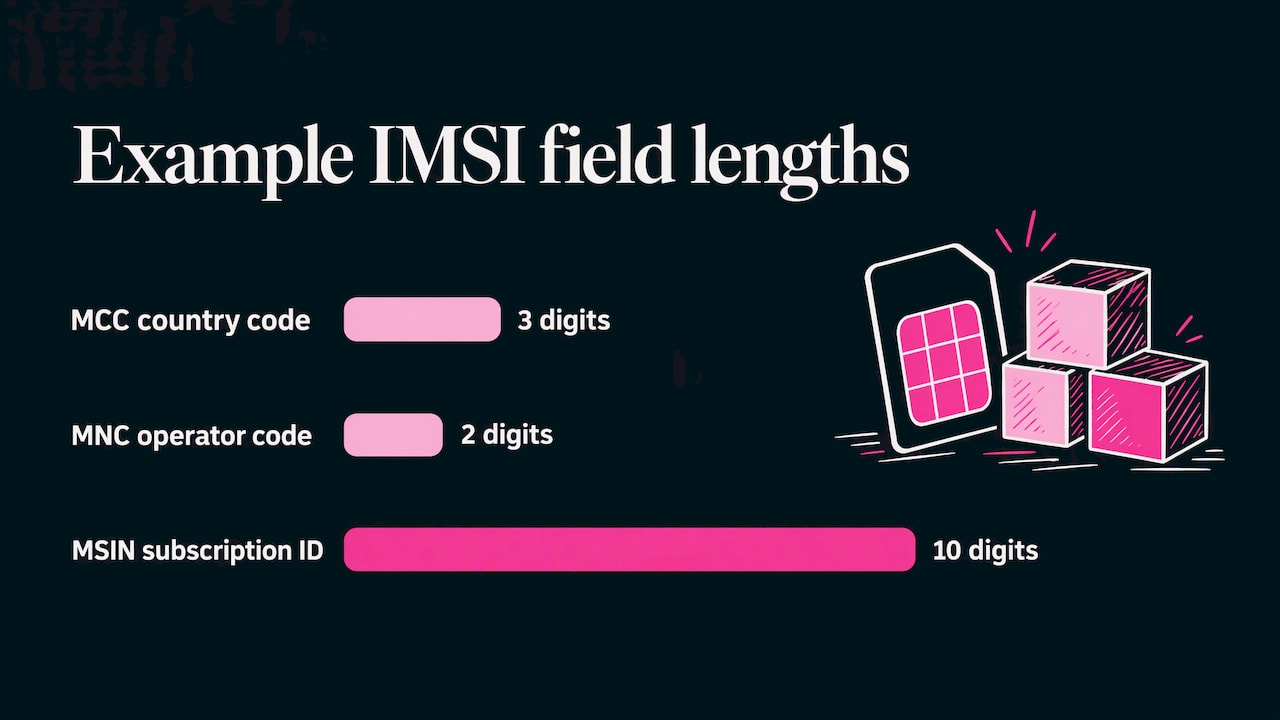
- It is a string of no more than 15 digits: a 3-digit country code (MCC), a 2 or 3-digit network code (MNC) and the subscription number (MSIN).
- It is stored on the SIM or eSIM profile, not in the handset, and it is not used for dialling.
- It is different from your phone number (what people call), your ICCID (the SIM's serial number) and your IMEI (the handset's serial number).
- Phones are not supposed to broadcast it constantly, but a fake mast can ask for it. That is how IMSI catchers work.
What an IMSI number is
When you join a mobile network, the operator creates a subscription for you in its core systems. The IMSI is the permanent key to that subscription. The International Telecommunication Union, the UN agency that runs global numbering, defines it in Recommendation E.212 (06/2024). The technical rules networks actually build to are in the 3GPP numbering specification, TS 23.003.
The US National Institute of Standards and Technology puts it simply in its security glossary: a unique number associated with a mobile subscriber and kept on the (U)SIM. The USIM is the application on a modern SIM card or eSIM profile that holds your network identity and the secret keys used to log you in.
Your phone number can be ported to another network, recycled or hidden. The IMSI is the identity the network itself relies on, which is why it carries more weight than most people realise.
How the digits are built: MCC + MNC + MSIN
TS 23.003 says an IMSI is made of decimal digits only and "shall not exceed 15" digits. It has three parts:
| Part | Name | Length | What it identifies |
|---|---|---|---|
| MCC | Mobile Country Code | 3 digits | The country the subscription belongs to (assigned by the ITU) |
| MNC | Mobile Network Code | 2 or 3 digits | The home operator in that country (assigned by the national regulator) |
| MSIN | Mobile Subscriber/Subscription Identification Number | The remaining digits, usually 9 or 10 | Your individual subscription on that operator |
Whether the network code has two or three digits depends on the country. European countries generally use two; North America uses three. That is why the MSIN is usually 10 digits in the UK and 9 in the US.
A worked example: the 3GPP specification itself uses the sample IMSI 234 15 0999999999. Read it left to right:
- 234 is a United Kingdom country code.
- 15 is the network code (in the UK, 15 belongs to Vodafone).
- 0999999999 is the subscription number on that operator's system.
A US example, from the Wikipedia cross-check, is 310 170 845466094: country 310, network 170, then a 9-digit MSIN. Same total, different split.
The layout is deliberate. TS 23.003 says IMSIs should be allocated so that a foreign network only has to read the MCC and MNC to know where to send a query. When you land abroad and switch on, the local network glances at the first five or six digits, works out who your home operator is and asks it whether to let you on. That is roaming in one sentence.
What networks use the IMSI for
Nobody types an IMSI. E.212 states it is not intended for dialling. Its jobs are behind the scenes:
- Registration and authentication. The network looks up your subscription record and the secret key stored with it, then challenges the SIM to prove it holds the same key.
- Roaming. The MCC and MNC route the request to your home network.
- Billing and subscription data. What you are allowed to use and what you are charged is filed against the subscription, not the handset.
- Reaching your phone. Nokia's network documentation notes the IMSI is stored in the SIM, sent by the phone to the network, and used in LTE paging calculations, the process of finding your phone to deliver a call or text.
IMSI vs ICCID vs IMEI vs phone number
These four get mixed up constantly. Each answers a different question.
| Number | Identifies | Where it lives | Changes when you... |
|---|---|---|---|
| IMSI | Your subscription | On the SIM or eSIM profile | Get a new SIM or profile |
| Phone number (MSISDN) | How people reach you | In the operator's records, linked to the IMSI | Change number (porting can keep it across networks) |
| ICCID | The SIM card or eSIM profile itself | Printed on physical SIMs, stored in the profile | Get a new SIM or profile |
| IMEI | The handset | In the phone hardware | Change phone |
The practical upshot: move your SIM to a new phone and the IMSI goes with it while the IMEI changes. Put a new SIM in the same phone and the IMSI changes while the IMEI stays. Anyone who can see both can link the old and new pieces together, so privacy-minded users think about the SIM and the handset as a pair.
Wikipedia's IMSI article also flags a newer wrinkle: some SIMs carry more than one profile, or a multi-IMSI profile, so a single card is not always a single IMSI.
How to find your IMSI
Short version: your phone probably will not show it to you, and that is by design.
- iPhone. Settings > General > About lists the serial number, EID, IMEI and ICCID, according to Apple's own support page. The IMSI is not on that list.
- Android. Some phones show it in the SIM status screen under About phone, depending on the manufacturer and Android version, but many current builds do not. Since Android 10, ordinary apps from Google Play cannot read it: the call that returns the subscriber ID (getSubscriberId) is restricted to apps holding a privileged permission. So an app from the Play Store that claims to show your IMSI on a modern phone deserves suspicion.
- Your operator. The network knows it. Some will tell you if you ask, others will not.
- Modems and dongles. On cellular modems, the standard AT command
AT+CIMI(defined in 3GPP TS 27.007) asks the SIM for its IMSI. This is for engineers rather than everyday phone users.
The number printed on a physical SIM card is the ICCID, usually starting with 89. It is not the IMSI, even though people often call it the "SIM number".
When your IMSI actually leaves the phone
Mobile standards try not to send the IMSI over the air more than necessary. Once you are registered, the network gives your phone a temporary identity (a TMSI on 2G and 3G, a GUTI on 4G and 5G, both defined in TS 23.003) and uses that for most exchanges. The temporary identity only means something locally and is meant to be swapped regularly.
The permanent IMSI tends to go out when the network does not recognise the temporary one, for example on first switch-on in a new area, or when the network sends an identity request asking for it outright. On 2G, 3G and 4G, that answer goes out unencrypted, because it happens before the phone and network have agreed keys.
5G standalone networks fix part of this. They use a SUPI (the permanent identity, usually still an IMSI) and send it concealed as a SUCI, which TS 23.003 describes as "a privacy preserving identifier containing the concealed SUPI". The subscription number is encrypted with the home network's public key, so a passive listener only sees the country and network codes. Two caveats matter. The standard also allows a "null scheme" in which the subscription number is sent in the clear, and protection only applies when your phone is actually on 5G standalone. If something pushes it down to 4G, 3G or 2G, the older rules apply.
The privacy risk: IMSI catchers
An IMSI catcher, also called a Stingray or cell-site simulator, poses as a legitimate mast. In a 2018 US House Science Committee hearing on IMSI catcher threats, one member described them as devices that mimic a legitimate cellular tower and trick nearby phones into connecting. The same hearing heard that a Department of Homeland Security pilot had spotted rogue cell-site simulators near the White House and the Pentagon. These are no longer only police tools.
Once your phone connects, the fake mast can send that identity request and log the IMSI. Collect it at one place and time, collect it again somewhere else, and you have a movement record for one subscription without ever learning its phone number.
Fake masts are not the only route. The peer-reviewed paper Wi Not Calling (ACSAC 2018, Arizona State University and Rochester Institute of Technology) set up a rogue Wi-Fi access point and found that phones using Wi-Fi Calling could leak the IMSI despite encryption. The researchers tested all four major US operators of the time and reported the vulnerabilities on each. That finding is about the setups they tested, but it shows the IMSI is treated as sensitive for good reason.
Who should care most:
- Journalists and activists: a fixed IMSI lets anyone who has logged it once recognise the same subscription at the next protest, meeting or border crossing.
- Travellers: a SIM registered with your passport carries an IMSI that leads back to you in every country you roam in.
- People with something to steal: a subscription tied to your name and number is a starting point for social engineering and SIM-swap attempts.
For the detail, see our guides to what an IMSI catcher is, how they track phones undetected, how to block them and whether your SIM card can be tracked.
Can an IMSI be changed?
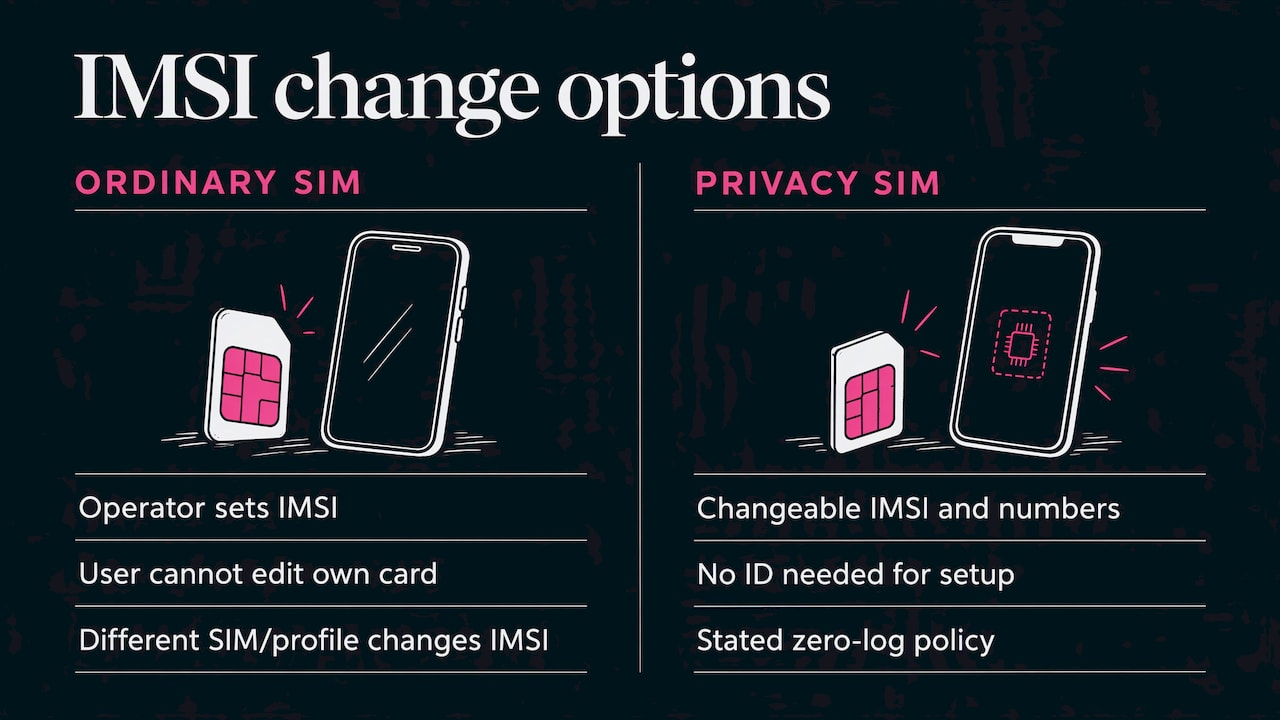
On an ordinary SIM, no. The operator writes the IMSI when it issues the SIM or eSIM profile, and you cannot edit it yourself. Getting a different IMSI normally means getting a different SIM or profile from the operator.
Privacy SIMs take a different approach. Our encrypted SIMs and eSIMs are sold with a changeable IMSI and dynamic number switching, so the identifier a network or fake mast sees is not a fixed marker you carry for years. We explain the reasoning in why changing your IMSI matters for privacy and what that does and does not protect against in encrypted SIMs and IMSI catchers.
The other half is registration. A changeable IMSI is far less useful if the SIM was bought with your passport. Ghost SIMs needs no ID to buy and runs a stated zero-log policy, so there is no customer file joining the subscription to your name.
Be realistic about what this does. Changing the IMSI deals with the subscription identifier. It does not change your handset's IMEI, encrypt what you type into apps or stop you being recognised by habits such as the same phone, the same home address every night and the same contacts. For messages, keep using end-to-end encrypted apps. For the handset, a hardened operating system closes other gaps.
Choosing a SIM when the IMSI matters
- Who is it registered to? If the answer is your legal name, every IMSI it carries points back to you.
- Can the identifier change? A subscription number that never changes is a long-term tracking handle.
- Where will you use it? Ours work in 180+ countries.
- How will you pay? Payment records are another link. We take cryptocurrency (Bitcoin, Ethereum, Monero, Zcash, Litecoin, USDT, Solana and more), cash in person in East London or by Royal Mail Special Delivery, and card or PayPal.
- What phone will it go in? A SIM is one layer. Our Secure PGP Encrypted Phone is a Google Pixel with GrapheneOS pre-installed.
Our secure SIM card guide covers how private SIMs work in more depth, and how phones are tracked on mobile networks covers the surveillance side.
Our SIMs
If you want a SIM where the IMSI is not a permanent link to your identity, start on our encrypted SIM page. At the time of writing (November 2026) the Russian PGP Encrypted eSIM is $100 and the Russian PGP Encrypted Physical SIM is $115, both one-off. Replacing a lost SIM costs $65 for an eSIM or $75 for a physical SIM. Data bundles ($50 to $500) and calling minutes (100 minutes for $200 up to 1,000 minutes for $1,800) are in the shop. Check the live pages before you buy, as prices can change.
FAQ
What does IMSI stand for?
International Mobile Subscriber Identity. The ITU's 2024 E.212 standard words the last part as "Subscription Identity", but it is the same number: the identity of one mobile subscription.
How many digits is an IMSI?
No more than 15. The first three are the country code, the next two or three are the network code, and the rest identify the subscription. Most IMSIs you will come across are exactly 15 digits.
Is the IMSI the same as my phone number?
No. Your phone number is what other people dial. The IMSI is what the network uses internally to identify and authenticate your subscription, and it is not used for dialling. The operator links the two in its own records.
Is the IMSI the same as the ICCID or IMEI?
No. The ICCID is the serial number of the SIM card or eSIM profile, and the IMEI identifies the handset. The IMSI identifies the subscription held on the SIM. A new SIM changes the IMSI and ICCID; a new phone changes the IMEI.
Can someone find out my IMSI?
Your operator holds it, and a fake mast can request it when your phone connects. On 5G standalone networks with concealment switched on, a passive listener sees only the country and network codes. A SIM with a changeable IMSI and no-ID registration limits how far a collected number can be tied back to you.
Sources
- Recommendation ITU-T E.212 (06/2024)
- 3GPP TS 23.003 v18.6.0: Numbering, addressing and identification
- NIST CSRC glossary: International Mobile Subscriber Identity
- Wikipedia: International mobile subscriber identity
- Nokia documentation: IMSI
- Apple: Find the serial number, EID or IMEI on your iPhone
- Android 10 privacy changes
- Bolstering Data Privacy and Mobile Security: An Assessment of IMSI Catcher Threats, US House hearing (2018)
- Wi Not Calling: Practical Privacy and Availability Attacks in Wi-Fi Calling (ACSAC 2018)