No-KYC eSIM & SIM Card: What It Means and Why It Matters (2026)
A no-KYC eSIM lets you connect to mobile networks without submitting a passport, national ID, or biometric verification. This guide explains how no-KYC SIMs work, what privacy they provide, what they cannot hide, and how to choose a reliable provider in 2026.
By GhostSims Team ·
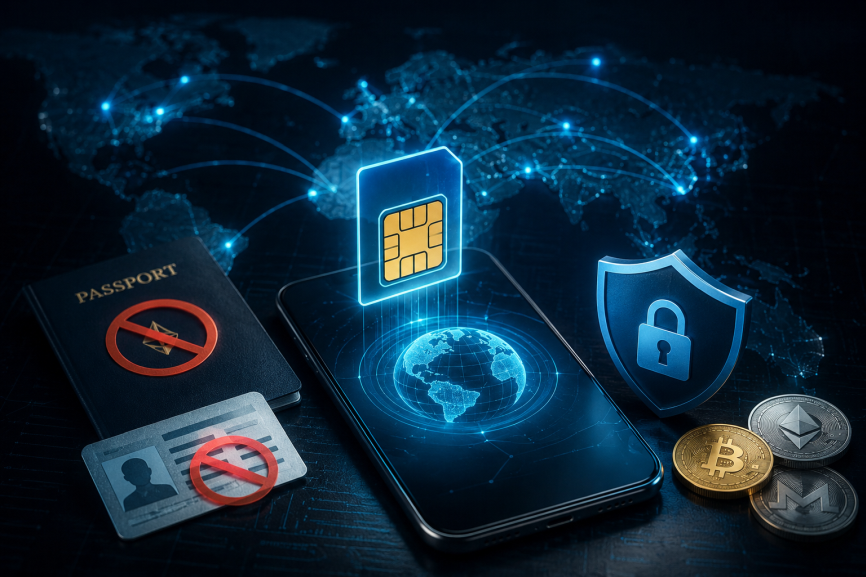
For privacy-conscious travellers, journalists, researchers, activists, business owners, and anyone uncomfortable handing passport details to another telecom provider, mobile connectivity can create a difficult trade-off. You need reliable data, but a conventional SIM registration process may connect your legal identity, payment information, phone number, and travel activity to a carrier account. GhostSims addresses this concern with no-ID SIM and eSIM options designed to reduce the personal information attached to mobile service while providing privacy-focused connectivity.
A no-KYC eSIM is a digital mobile subscription that can be purchased and activated without completing conventional Know Your Customer identity verification.
In practical terms, the provider does not ask you to upload a passport, national identity card, driving licence, biometric scan, or proof of address before issuing the eSIM profile.
That is an important privacy distinction. It does not, however, make your phone invisible or remove every technical record created when it connects to a mobile network.
What Does KYC Mean?
KYC stands for Know Your Customer. It refers to procedures used by organisations to identify customers and verify that they are who they claim to be.
Formal KYC is most closely associated with banks, payment companies, cryptocurrency exchanges, and anti-money-laundering compliance. The Financial Action Task Force describes customer due diligence as identifying a customer and verifying that identity using reliable, independent information or documentation.
A conventional verification process may request:
Your full legal name
Date of birth
Residential address
Government-issued identification
A photograph or live facial scan
Payment and billing information
An existing phone number or email address
In telecommunications, similar requirements are often described as SIM registration, subscriber registration, identity verification, or real-name registration.
The terminology differs, but the result is broadly the same: the mobile subscription is connected to an identified individual.
Why Do Mobile Carriers Require KYC or SIM Registration?
Mobile providers may verify subscriber identities because national laws require it, because their own fraud controls demand it, or because particular services involve additional regulatory obligations.
Governments commonly introduce SIM registration in an attempt to combat fraud, scams, organised crime, and misuse of mobile numbers. Under these systems, an operator may be required to check and record a customer’s identity before activating a prepaid SIM. Some countries also require biometric information.
However, there is no single worldwide rule. Requirements vary significantly by country.
United Kingdom
The UK does not currently impose a general legal requirement for prepaid SIM users to register their personal details with a mobile operator. Ofcom confirmed this position in its 2024 consultation on reducing mobile messaging scams.
A UK provider may still request a name, address, payment method, contact details, or other information under its own account and fraud-prevention procedures.
European Union
There is no single rule that applies identically to every EU member state. Some countries require formal identification before activating a prepaid SIM, while requirements and verification methods differ elsewhere.
Users should therefore check the current laws and carrier procedures in the specific country where a local SIM will be purchased.
United States
The United States does not have one universal federal consumer SIM-registration regime equivalent to the strict national real-name systems used in some other countries.
US carriers and retailers may nevertheless collect names, addresses, payment information, device details, or identification for particular products, account types, financing arrangements, fraud checks, or number-transfer requests.
Elsewhere, the process can be considerably stricter. Depending on the jurisdiction, a customer may need to provide a passport, national identity number, proof of residence, fingerprint, or facial verification before service is activated.
This fragmented legal landscape is one reason international no-KYC services appeal to travellers. They may allow someone to arrange connectivity before departure rather than completing a new local registration process after every border crossing.
What Does a No-KYC eSIM Actually Mean?
A genuine no-KYC eSIM generally means that the provider issues the cellular subscription without requiring verified government identification from the customer.
The eSIM itself is not a special privacy protocol. It is a remotely provisioned mobile subscription profile downloaded to a secure component within a compatible phone or device. GSMA documentation explains that an eSIM profile is prepared through remote provisioning infrastructure and downloaded to an embedded eUICC rather than being supplied only on a removable plastic card.
The privacy difference comes from how the service is sold, registered, paid for, managed, and logged.
A no-KYC process may include the following characteristics.
No passport or identity-document upload
The provider does not require a passport, driving licence, national identity card, or similar document before delivering the eSIM.
No biometric identity check
The customer is not asked to provide a fingerprint, facial scan, selfie-verification video, or other biometric evidence.
No verified subscriber name
The service is not issued through an account that must be matched to the customer’s official legal identity.
Minimal registration information
Some services require no traditional account. Others may ask for an email address so they can deliver a QR code, process an order, or provide support.
This distinction matters. No-KYC does not necessarily mean no data collection.
A provider could avoid passport verification while still collecting:
Email addresses
IP addresses
Payment information
Device or browser data
Order histories
Customer-support messages
Connection or network records
Before buying, read the provider’s privacy policy and checkout requirements rather than relying only on a “no-KYC” label.
Privacy-conscious payment options
Some KYC-free eSIM providers accept cryptocurrency so customers are not forced to use a debit or credit card bearing their name.
Cryptocurrency should not automatically be described as untraceable. Bitcoin transactions, for example, are recorded publicly and permanently on the blockchain. Address reuse, exchange records, wallet activity, and transaction analysis can potentially connect payments.
Readers who want to reduce conventional payment exposure can follow GhostSims’ guide on how to buy with crypto.
Does an eSIM Require KYC?
No. The eSIM format does not itself determine whether identity verification is required.
A standard eSIM purchased directly from a domestic mobile carrier may require the same identity and account information as a physical SIM. An international provider may be able to issue a profile without asking for formal identification.
The important questions are:
Which company is selling or issuing the service?
Which laws apply to that provider?
What information is collected during checkout?
Which network or roaming partners deliver the connection?
Does the service include only data, or also a phone number, voice, and SMS?
What technical and account records are retained?
Whether a subscription arrives on plastic or through a digital download is mainly a provisioning difference. Privacy depends more heavily on registration, payments, logging, network architecture, account recovery, device configuration, and user behaviour.
Is a No-KYC eSIM Legal?
Purchasing or using a no-KYC eSIM is not inherently illegal, but its legality cannot be reduced to one worldwide answer.
International eSIM providers may issue roaming profiles under arrangements that differ from purchasing a local subscription directly from a domestic carrier. This can allow a traveller to use an international profile in a destination where locally sold SIM cards require identity registration.
However, it would be inaccurate to say these services operate outside telecommunications regulation.
The provider, home-network operator, roaming partners, payment companies, and user may all be subject to applicable laws and contractual requirements.
The practical position is:
A no-KYC service may be lawful where the provider is permitted to issue it.
A country may require registration for locally sold SIMs without necessarily prohibiting foreign roaming profiles.
Some jurisdictions impose broader restrictions on communications, encryption, imported devices, or foreign mobile services.
Using any SIM for fraud, harassment, unauthorised access, or another offence remains illegal.
Travellers should check current rules in every destination before relying on a particular service.
SIM registration is widespread internationally. GSMA reported in 2021 that 157 countries had implemented mandatory prepaid SIM-registration policies, although individual laws and enforcement can change over time.
That is why readers should avoid assuming that the rules in the UK, United States, or one EU country apply everywhere else.
Why Does No-KYC Matter at the SIM Level?
Most privacy advice focuses on secure browsers, messaging applications, encrypted email, or VPNs. Those tools can be useful, but they operate separately from the subscriber-registration process used to obtain cellular service.
When a SIM or eSIM is registered in your name, the provider may be able to connect the customer account to information such as:
An identity document
A billing profile
A home address
A personal email address
A mobile number
Activation and account records
Customer-support interactions
Payment history
A no-KYC service can remove or reduce this direct account-level identity connection.
Consider a journalist arriving in another country for a short assignment. Purchasing a local SIM could require handing a passport to an airport retailer and creating another named subscriber record. Obtaining an international eSIM before travelling may avoid creating that additional local registration record.
The concern does not need to involve a high-risk investigation. An ordinary traveller may simply prefer not to distribute passport scans across multiple telecom companies, airport kiosks, reseller platforms, and third-party verification services.
Data minimisation has value on its own. Identity information that a provider never collects cannot later be exposed through a breach of that provider’s customer-verification database.
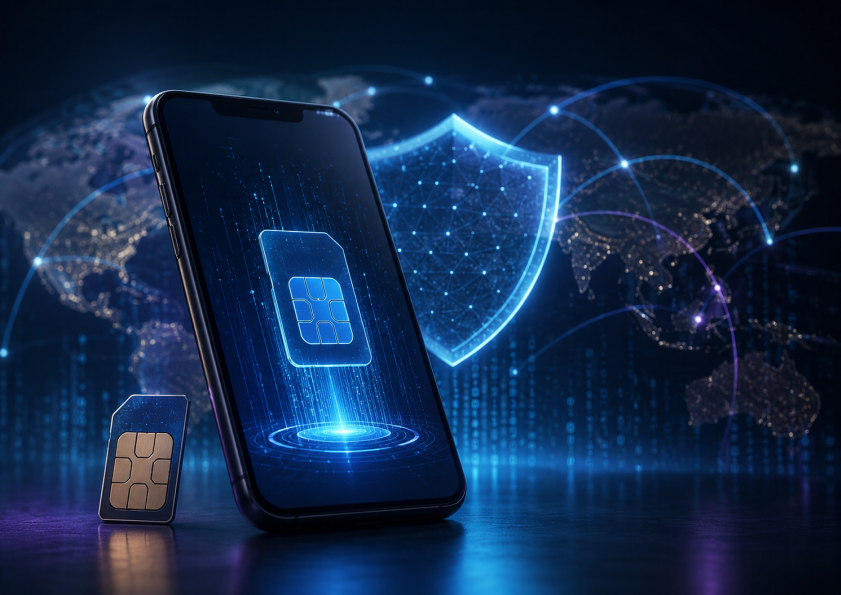
What a No-KYC eSIM Can Protect
A well-designed service can help reduce:
Direct linkage between a passport and a mobile subscription
Exposure of identity documents during travel
Dependence on a personal payment card
The number of telecom providers storing your identity
Connection between temporary connectivity and your normal carrier account
Administrative friction when arranging mobile service abroad
The effect of a breach involving the provider’s identity records, provided those records were genuinely never collected
This is why comparisons of the best no-KYC eSIM providers should examine more than data allowances, coverage maps, and price.
The signup process, payment options, privacy policy, logging practices, support procedures, and account-recovery methods are equally important.
What a No-KYC eSIM Cannot Protect
No-KYC removes one identity layer. It does not eliminate every signal produced by a connected mobile device.
It does not hide the device from the mobile network
A serving network must process technical identifiers and signalling information to authenticate the subscription and deliver cellular service.
No mobile provider can route data to a device without recognising that a valid subscription is connected.
It does not remove the phone’s IMEI
Mobile devices have equipment identifiers, including the International Mobile Equipment Identity. Apple, for example, lists the IMEI separately from the EID and ICCID associated with SIM and eSIM functions. Changing a SIM profile does not automatically change the phone’s hardware identifier.
It does not prevent network-based location records
Mobile networks must determine which network area or cell is serving the device. The precision and retention of location information depend on the operator, network, technology, and applicable laws.
Applications with GPS or location permission may collect more precise data independently of the SIM provider.
It does not encrypt every call or message
A no-KYC eSIM does not automatically make conventional voice calls or SMS messages end-to-end encrypted.
Communication security depends on the service, protocol, device, application, provider architecture, and the people at each end of the conversation.
It does not hide personal account logins
Using a KYC-free connection and immediately signing in to your usual Google, Apple, Meta, banking, or personal email accounts may reconnect the session to your established identity.
It does not eliminate payment trails
A personal bank card, identity-verified cryptocurrency exchange, reused wallet, or identifiable delivery address may still connect an order to the purchaser.
It does not stop behavioural correlation
Repeated locations, travel patterns, contacts, login times, device reuse, and communication habits can allow separate activities to be associated with the same person.
It does not replace a VPN
A no-KYC profile reduces the identity information collected when obtaining cellular service. A VPN protects supported internet traffic between your device and the VPN server.
They address different parts of the privacy problem.
The realistic benefit of no-KYC is reduced subscriber-level identity exposure, not complete invisibility.
Is No-KYC the Same as an Anonymous eSIM?
Not exactly.
“No-KYC” describes a particular onboarding feature: the provider does not conduct conventional identity verification before issuing the service.
“Anonymous eSIM” is a broader term that providers and reviewers may use to describe a combination of features, such as:
No-ID registration
Minimal account information
Cryptocurrency payment
Reduced logging
Private routing
Temporary accounts
Changeable subscriber profiles
Additional communication-security tools
A service can be no-KYC without delivering strong anonymity.
For example, it could avoid asking for a passport while still requiring a personal email address, accepting only named bank cards, storing extensive logs, or linking each purchase to a persistent account.
A better question is: What evidence could connect the purchase, subscription, device, network activity, and user?
How to Evaluate a KYC-Free eSIM Provider
Before purchasing, examine the provider’s actual processes rather than relying on a privacy badge.
1. Review the checkout requirements
Check whether the provider asks for a legal name, home address, passport, existing telephone number, date of birth, or proof of residence.
2. Check how the eSIM is delivered
An eSIM is usually installed through a QR code, activation link, carrier application, or account dashboard.
Determine whether the provider requires a permanent personal email address or allows a more compartmentalised delivery method.
3. Examine the payment options
Look for methods that do not force you to use your everyday bank card. Do not assume that paying with cryptocurrency automatically removes every payment trail.
4. Read the privacy and logging policy
Look for clear information about:
Order records
IP addresses
Device information
Connection data
Support communications
Retention periods
Third-party processors
Legal disclosure procedures
A vague “zero logs” statement is less useful than a policy explaining exactly which categories of information are and are not retained.
5. Confirm whether the plan is data-only
Many privacy-focused international eSIMs provide mobile data but do not include a conventional phone number, inbound SMS, outbound SMS, or traditional voice calling.
This matters when you need:
Verification texts
Two-factor authentication codes
Local application registration
Incoming telephone calls
Emergency calling
A permanent business number
Always check the product details rather than assuming every eSIM includes the same communication features.
6. Verify device and destination compatibility
Confirm that your phone:
Supports eSIM
Is network-unlocked
Supports the necessary frequency bands
Can install another profile
Works with the provider’s activation process
You should also review coverage and pricing for the exact destination instead of relying only on a broad “global coverage” statement.
7. Reject impossible privacy promises
No provider can make cellular signalling, device identifiers, physical location, personal account activity, and user behaviour disappear.
A company that clearly explains its limits is generally more credible than one promising total untraceability.
How GhostSims Provides No-KYC Connectivity
GhostSims currently states that its encrypted SIM and eSIM products are available without ID verification and include anonymous registration, worldwide coverage, and a zero-log policy. Its product page offers both an instantly delivered digital eSIM and a physical SIM option. These are provider claims and should be assessed alongside the applicable product terms and privacy policy.
The stated privacy-focused features include:
No government-issued ID required at purchase
Digital eSIM and physical SIM options
Cryptocurrency payment availability
Reduced dependence on a conventional named carrier account
International connectivity
Additional secure-communication features
These controls primarily address registration and account-level exposure.
Users must still consider device identifiers, local-network visibility, personal applications, payment history, delivery information, account logins, and their own operational habits.
That distinction matters. A credible no-KYC service should reduce unnecessary identity links rather than suggesting that ordinary cellular networks stop generating technical information.
Frequently Asked Questions
What is a no-KYC eSIM?
A no-KYC eSIM is a digital mobile subscription issued without conventional identity verification. The provider does not require a passport, national identity document, or similar government-issued identification before supplying the service.
Is no-KYC the same as anonymous?
No. No-KYC means the provider does not perform standard identity verification during signup. Broader anonymity also depends on payment methods, email requirements, logging, device identifiers, applications, location exposure, personal account use, and behaviour.
Does eSIM require KYC?
Not inherently. An eSIM is a method of digitally provisioning a mobile subscription. Whether identity verification is required depends on the provider, applicable law, network arrangements, and type of service.
Can I get a SIM without KYC?
Yes, in some circumstances. Certain prepaid markets and international providers offer service without formal identity verification. Availability depends on local laws and the provider’s procedures.
A company that does not request a passport may still collect contact, payment, order, or technical information.
Are there no-KYC eSIM providers?
Yes. Several international and privacy-focused companies advertise eSIM services that do not require government-issued identification.
However, the meaning of no-KYC varies. Compare registration requirements, payment options, account data, logging policies, coverage, and whether the plan includes voice or SMS.
Which countries allow no-KYC eSIMs?
There is no permanent universal list because laws, carrier procedures, and enforcement can change.
The UK currently does not impose general mandatory registration on prepaid users, while requirements across Europe and other regions vary by country. International roaming profiles may operate in destinations where locally issued SIM cards require identification.
Users should check the current rules for both the provider’s jurisdiction and their destination.
Can I buy a no-KYC eSIM with crypto?
Yes. Some providers accept cryptocurrency, which can reduce reliance on a personal debit or credit card.
Crypto is not automatically anonymous. Public blockchain records, identity-verified exchanges, reused addresses, and wallet activity may still create links to the buyer.
Does a no-KYC eSIM include a phone number?
Sometimes, but many international privacy-focused plans are data-only.
Before buying, check whether the service includes a dedicated telephone number, inbound SMS, outbound SMS, conventional voice calls, or only internet access.
Can a no-KYC eSIM be tracked?
The subscription may not be directly registered under your verified name, but the connected device still communicates with cellular networks.
Device identifiers, cell-site activity, applications, account logins, payment information, and behavioural patterns may still permit tracking or correlation.
Reduce the Identity Attached to Your Mobile Service
A no-KYC connection changes what a provider needs to know before giving you cellular access. It can reduce passport exposure, minimise account data, and help separate temporary connectivity from your everyday carrier identity.
It cannot remove every network record or compensate for unsafe applications, a compromised phone, identifiable payments, repeated device use, or personal account logins.
For users who understand those limits and want a more privacy-conscious starting point, GhostSims offers a no-KYC eSIM alongside its physical encrypted SIM option.
Order Your Ghost SIM Online or Contact us on Whatsapp +44 7375 695524