SIM Card Registration Laws by Country (Full List)
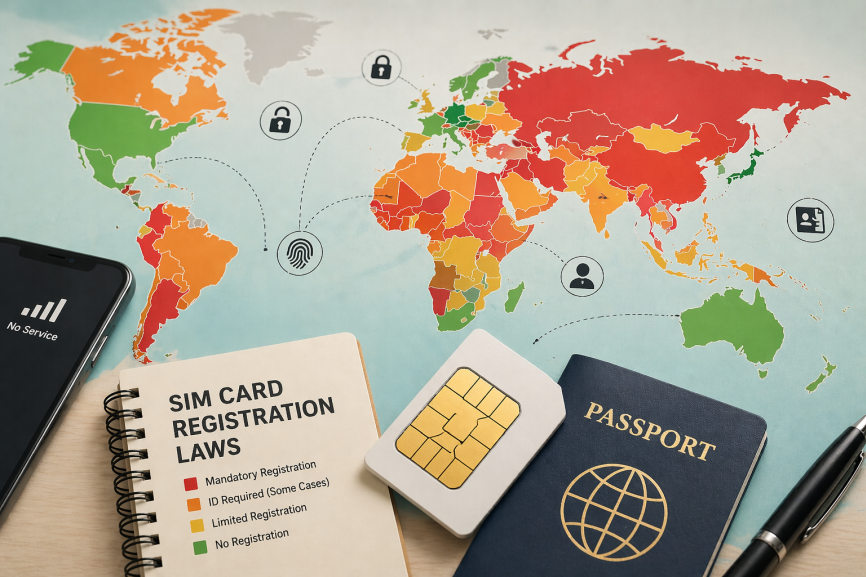
SIM card registration laws now affect over 160 countries, requiring users to provide ID, and in some cases biometric data, just to activate a mobile connection. While these rules aim to improve security, they also reduce privacy and make anonymous communication nearly impossible. Understanding how these laws vary globally - and what alternatives exist - is essential for anyone who values secure and private connectivity.
By GhostSims Team ·

If you’re a traveler, privacy-conscious user, journalist, or business owner operating across borders, SIM card registration laws can quickly become a frustrating maze. You might expect to just buy a SIM and get connected-but instead, you’re asked for passports, biometrics, even device registration. In many countries, failing to comply can get your SIM deactivated instantly. That’s where understanding the global landscape-and solutions like Ghost Sim - becomes essential for staying connected without compromising your privacy.
Why SIM Card Registration Exists (And Why It’s a Problem)
Governments often justify SIM registration laws as a way to:
Prevent fraud and scams
Combat terrorism and cybercrime
Improve national security
Here’s the thing… while that sounds reasonable, the reality is different.
The Real Frustration Users Face
You lose anonymity instantly when buying a SIM
Your personal identity is tied to every call and message
In some countries, biometric data (fingerprints, facial scans) is required
Travelers often face activation delays or outright rejection
Too many people assume they can just “buy a prepaid SIM anonymously”-only to discover that’s no longer possible in most places.
SIM Card Registration Laws by Region
Let’s break down what actually happens across different parts of the world.
Asia-Pacific: Strict Registration & SIM Limits
Most countries in Asia enforce mandatory SIM registration, often with strict limits.
Countries with Mandatory Registration:
India
Pakistan
China
Bangladesh
Indonesia
Malaysia
Philippines
Thailand
Vietnam
Singapore
Key Restrictions:
Indonesia: Max 3 SIMs per user
Singapore: Max 3 SIMs per operator
Thailand: Up to 5 SIMs
Taiwan: Only 1 SIM allowed
Extra Requirements:
IMEI registration (India, Pakistan, China)
Biometric verification in some regions
In countries like Pakistan, tourists can only get temporary SIMs (up to 120 days)-after that, they’re cut off.
Europe: Mixed but Increasingly Regulated
Europe isn’t uniform, but the trend is clear: more regulation, less anonymity.
Countries Requiring SIM Registration:
Germany
France
Spain
Italy
Belgium
Denmark
Poland
Countries with Looser Rules:
Some EU nations still allow limited flexibility, but it’s shrinking fast
Around 19 out of 28 EU countries require prepaid SIM registration.
In countries like the UK where regulations are evolving, understanding what still works in practice can help you make smarter choices when looking for an anonymous SIM card.
Africa & Middle East: Some of the Strictest Laws
This region has some of the most aggressive SIM tracking policies.
Examples:
Nigeria: Mandatory registration + risk of deactivation
Kenya: Often requires biometric data
UAE & Saudi Arabia: Strict ID verification (passport/emirates ID)
In places like the UAE where SIM registration is tightly enforced, it’s worth understanding what’s actually possible before you try to buy a SIM without ID.
What This Means:
You cannot buy a SIM without verified identity
Governments may link SIM data to national databases
Americas: More Flexible (But Not Fully Anonymous)
United States:
No federal law requiring SIM registration
However, many carriers still request ID voluntarily
Latin America:
Argentina, Brazil, Mexico → Mandatory registration
Increasing enforcement across the region
The U.S. is one of the few major markets where true prepaid anonymity is still partially possible - but even that is changing.
Countries With No or Limited SIM Registration
These are becoming rare - but they still exist.
Examples:
New Zealand
Tonga
Kiribati
Special Case:
Japan:
Voice/SMS SIMs require ID
Data-only tourist SIMs often don’t require registration
While most countries enforce strict ID rules, there are still a few places where anonymous SIM cards are possible under specific conditions.
Which Countries Require IMEI Registration?
Some countries go beyond SIM tracking and require your device to be registered.
Countries with IMEI Registration:
India
Pakistan
China
Turkey
This means your phone itself is tied to your identity, not just the SIM.
What Documents Are Typically Required?
When registering a SIM, expect to provide:
Passport (for tourists)
National ID card (for residents)
Biometric data (in some countries)
Photo verification
Address details (occasionally)
Some countries now use eKYC systems, allowing digital verification at kiosks or online.
Why “Anonymous SIM Cards” Don’t Work Anymore
Let’s be real - most so-called “anonymous SIMs” are no longer truly anonymous.
Common Failed Solutions:
Buying SIMs from third parties → often already registered (and risky)
Using fake IDs → illegal in many countries
Roaming SIMs → still traceable via networks
The result?
You think you’re private… but your data is still being logged somewhere.
In many regions where strict ID rules apply, options are limited - but there are still ways to navigate this, as explained in this guide on buying a SIM card without ID.
A Smarter Alternative: Secure, Encrypted SIM Solutions
If navigating global SIM laws feels overwhelming, that’s because it is.
This is where solutions like Ghost Sim come in.
Instead of relying on local SIM registration systems, Ghost Sim offers:
Encrypted calling and messaging
No exposure of personal identity
Works across multiple countries
Compatible with most devices
If you need a reliable option, you can explore the full range of secure SIM solutions directly on the
Ghost Sim shop page, where different privacy-focused plans are available depending on your use case.
If you’re unsure where to start, it helps to understand where to buy anonymous SIM cards online from trusted and secure sources.
Which SIM Card Works in Every Country?
No single SIM works literally everywhere - but some come close.
Options:
International roaming SIMs
eSIM global providers
Encrypted SIM solutions (like Ghost Sim)
Each has trade-offs:
Roaming SIMs → convenient but not private
eSIMs → flexible but still tied to identity
Encrypted SIMs → best for privacy + security
If you’re traveling across multiple countries, choosing the right option becomes critical - especially when comparing the best anonymous SIM cards for international use.
Best Placement for SEO & Context:
Which SIM Card Uses All Networks?
Some global SIM providers partner with multiple carriers.
This allows:
Automatic switching between networks
Better coverage in remote areas
However, most still require user identification at some level - another reason privacy-focused users look for alternatives.
What Happens If You Don’t Register Your SIM?
Consequences vary by country, but typically include:
Immediate SIM deactivation
Loss of service (calls, SMS, data)
Blacklisting of your number or device
Legal penalties in extreme cases
In countries like Nigeria or India, enforcement is strict and automated.
Final Thoughts: The Global Trend Is Clear
SIM card registration is expanding - not shrinking.
More countries are introducing biometric verification
Governments are linking SIMs to national identity systems
True anonymity is becoming harder to achieve
For most users, this creates a tough choice:
Stay compliant and give up privacy
Or look for smarter, secure alternatives
If privacy matters to you, it’s worth considering solutions designed for today’s reality-not yesterday’s loopholes.
Order Your Ghost SIM Online or Contact us on Whatsapp +44 7375 695524